Choosing the right backflow preventer is an important part of protecting a property’s potable water supply. But with different assemblies available—including pressure vacuum breakers (PVB), double check valve assemblies (DCVA), and reduced pressure zone assemblies (RPZ)—it is easy to wonder which device is actually appropriate for your property.
The answer is not simply based on whether you own a home, office, restaurant, or commercial building. Backflow protection depends on the specific cross-connection, potential hazard, water pressure conditions, possibility of backsiphonage or backpressure, system configuration, and applicable requirements.
For property owners in West Chester, PA, understanding these differences can make it easier to recognize an existing backflow device, understand testing requirements, and know when professional inspection, repair, or installation may be necessary.
What Is a Backflow Preventer?
A backflow preventer is a device or assembly designed to help stop water from flowing backward into a potable water supply.
Normally, water travels from the public or private supply toward the fixtures and equipment that use it. Under certain pressure conditions, however, water can move in the opposite direction. If a cross-connection exists, that reverse flow can potentially introduce non-potable water or other contaminants into the drinking water system.
Backflow can generally occur through two pressure conditions: backsiphonage and backpressure.
What Is Backsiphonage?
Backsiphonage occurs when the pressure in the potable water supply drops below the pressure on the downstream side of a connection. The resulting negative pressure can pull water backward through a cross-connection.
A sudden interruption of water service or a significant pressure drop can create conditions where backsiphonage becomes possible.
What Is Backpressure?
Backpressure occurs when the downstream pressure becomes greater than the pressure in the potable water supply.
Pumps, elevated tanks, boilers, and other pressurized systems can create conditions where downstream pressure pushes water in the reverse direction.
Understanding whether a system can experience backsiphonage, backpressure, or both is an important part of selecting appropriate backflow protection.
PVB vs. DCVA vs. RPZ: What Is the Difference?
PVB, DCVA, and RPZ assemblies do not provide identical protection.
A pressure vacuum breaker, or PVB, is a testable assembly designed primarily to protect against backsiphonage. Pennsylvania DEP guidance explains that a PVB prevents backsiphonage but not backpressure.
A double check valve assembly, or DCVA, uses two independently acting check valves and is designed to protect against backsiphonage and backpressure in appropriate applications. Pennsylvania DEP identifies DCVA protection for non-health-hazard risks.
A reduced pressure zone assembly, commonly called an RPZ or RPZD, also protects against backsiphonage and backpressure. It includes a relief valve between two check valves and is used where a higher level of protection is required, including health-hazard applications identified by Pennsylvania guidance.
This is why choosing a backflow preventer should begin with the actual plumbing application rather than simply choosing the device that appears to offer the most protection.
What Is a PVB Backflow Preventer?
PVB stands for Pressure Vacuum Breaker.
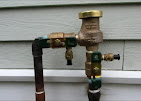
A PVB is a testable backflow prevention assembly that uses a check valve and an air inlet valve to protect against backsiphonage. It is equipped with test cocks and shutoff valves and is commonly associated with applications such as irrigation systems.
Pennsylvania DEP describes the PVB as a testable device that prevents backflow caused by backsiphonage but not backpressure.
Where Might a PVB Be Used?
PVB applications can include certain:
- Irrigation systems
- Lawn sprinkler systems
- Landscape watering systems
- Outdoor water connections
- Other installations where the applicable requirements call for vacuum-breaker protection
However, the presence of an irrigation system does not automatically mean that every property requires the same assembly. The specific plumbing arrangement and applicable requirements still need to be considered.
What Should Property Owners Know About PVB Testing?
Because a PVB is a testable assembly, it can be evaluated using the applicable field-testing procedure.
A professional inspection can also identify visible problems such as corrosion, damaged components, leaking valves, poor installation conditions, or other issues that may affect performance.
If you are unsure what type of device is installed at your property, a backflow device inspection can help identify the assembly and its condition.
What Is a DCVA Backflow Preventer?
DCVA stands for Double Check Valve Assembly.
A DCVA uses two independently acting check valves to help prevent reverse water flow. It is designed for applications where protection against both backsiphonage and backpressure is needed, subject to the applicable hazard classification and requirements.
Pennsylvania DEP guidance describes the DCVA as a testable device that protects against both backsiphonage and backpressure and recommends it for non-health-hazard risks.
How Does a DCVA Work?
A DCVA contains two check valves arranged in series. If water attempts to flow backward, the check valves are designed to prevent that reverse flow.
The assembly also includes test cocks and shutoff valves that allow qualified personnel to perform applicable testing and maintenance.
Where Can a DCVA Be Used?
Depending on the specific application and applicable requirements, DCVA assemblies may be used in situations involving:
- Irrigation
- Certain fire protection systems
- Commercial plumbing systems
- Other non-health-hazard connections
Pennsylvania DEP’s guidance lists irrigation systems and several other facility types among applications where DCVA protection may be applicable, while emphasizing that the device selection must correspond to the specific risk and requirements.
If an existing DCVA has failed a test or is showing signs of wear, backflow testing services can help determine whether the assembly is performing properly.
What Is an RPZ Backflow Preventer?
RPZ stands for Reduced Pressure Zone.
An RPZ assembly contains two check valves and a relief valve located between them. The relief valve provides an additional layer of protection and can discharge water when the assembly detects an appropriate differential-pressure condition.
Pennsylvania DEP identifies RPZ assemblies as providing protection against both backsiphonage and backpressure and recommends them for health-hazard risks.
Why Is an RPZ Different From a DCVA?
Both assemblies can protect against backsiphonage and backpressure, but their construction and application considerations are different.
The defining feature of an RPZ is the reduced-pressure zone and relief valve between the two check valves.
Because an RPZ can discharge water through its relief valve, installation requires appropriate consideration of drainage, accessibility, freezing conditions, and maintenance space.
Where Might an RPZ Be Used?
Depending on the specific cross-connection and hazard, RPZ assemblies can be considered for applications involving greater potential health risk.
Examples can include certain:
- Commercial facilities
- Industrial systems
- Chemical-related connections
- Healthcare or laboratory environments
- Commercial equipment
- Other higher-hazard applications
The Pennsylvania DEP’s guidance includes examples of facilities and applications where RPZ protection may be appropriate.
For a new assembly or replacement project, backflow installation services can help address the installation requirements associated with the selected device.
How Do You Know Which Backflow Preventer Your Property Needs?
There is no reliable one-size-fits-all answer.
The appropriate backflow preventer should be determined by looking at several factors.
1. What Is the Cross-Connection?
Start by identifying what the potable water supply is connected to.
An irrigation system, boiler, chemical process, swimming pool, commercial machine, or other connection can create different backflow risks.
2. What Is the Degree of Hazard?
The potential consequences of contamination matter.
A connection involving a substance that could present a health hazard may require a different level of protection than a connection involving a lower-risk condition.
3. Is Backpressure Possible?
If downstream pressure can exceed the supply pressure, the selected protection needs to account for backpressure.
4. Is Backsiphonage Possible?
If a pressure drop could create a vacuum condition and draw downstream water backward, backsiphonage protection needs to be considered.
5. What Are the System Conditions?
Pressure, elevation, continuous-pressure conditions, available installation space, drainage, freezing exposure, and accessibility can all influence installation and maintenance.
6. What Requirements Apply to the Property?
Applicable state guidance, water supplier requirements, plumbing requirements, local rules, and manufacturer instructions should be considered before installing or replacing an assembly.
The Pennsylvania DEP’s backflow guidance specifically notes that its device recommendations are not intended to replace ordinances or standards developed by a water supplier.
Backpressure vs. Backsiphonage: Why the Difference Matters
Understanding these two terms makes the PVB vs. DCVA vs. RPZ comparison much easier.
Backsiphonage
Think of backsiphonage as a suction effect.
When supply pressure falls, downstream water may be pulled backward toward the potable water supply.
This is why pressure vacuum breakers are designed around protection from backsiphonage.
Backpressure
Think of backpressure as a pushing effect.
When downstream pressure becomes greater than supply pressure, water can be pushed backward.
This can occur in systems involving pumps, boilers, elevated tanks, or other pressure-producing equipment.
A PVB does not provide backpressure protection according to Pennsylvania DEP guidance, while DCVA and RPZ assemblies can provide protection against both backsiphonage and backpressure when appropriately selected and installed.
Does a Residential Property Need a Backflow Preventer?
A residential property may contain several potential cross-connections.
Examples include:
- Lawn irrigation
- Sprinkler systems
- Swimming pools
- Outdoor hose connections
- Boilers
- Water treatment equipment
- Other specialized plumbing equipment
However, homeowners should not assume that every residential property needs the same type of backflow preventer.
The appropriate protection depends on the specific installation and applicable requirements.
If you have an existing device but do not know whether it is a PVB, DCVA, or another assembly, a professional backflow inspection can help identify the equipment and potential issues.
What Backflow Protection Does a Commercial Property Need?
Commercial properties can have more complex plumbing systems and multiple potential cross-connections.
Examples include:
- Restaurants
- Office buildings
- Retail properties
- Apartment buildings
- Schools
- Healthcare facilities
- Manufacturing facilities
- Car washes
- Commercial irrigation systems
- Boiler systems
- Fire protection systems
The correct assembly depends on the specific connection and hazard rather than the word “commercial” alone.
For businesses, routine testing and prompt attention to failed assemblies can also help prevent a small backflow problem from becoming a larger operational issue.
If a commercial assembly has failed or needs service, commercial backflow repair is a relevant next step.
Common Backflow Preventer Problems
Backflow assemblies are mechanical devices, so their components can eventually experience wear, contamination, corrosion, freezing, or other problems.
Common issues include:
Leaking Components
Water leaking from an assembly may indicate a component or installation problem that requires investigation.
Failed Check Valve
A worn, damaged, or contaminated check valve can affect the assembly’s ability to prevent reverse flow.
Relief Valve Discharge
An RPZ relief valve that is discharging water should not simply be ignored. The cause should be evaluated to determine whether the assembly needs testing, cleaning, repair, or replacement.
Corrosion
Outdoor installations can be exposed to moisture, weather, and temperature changes that contribute to corrosion.
Freeze Damage
Cold temperatures can damage water-filled assemblies. Installation and protection should account for freezing conditions.
Failed Test
A failed backflow test does not automatically mean that the entire assembly must be replaced.
The appropriate response depends on the condition of the device, the failed component, the assembly’s suitability, and applicable requirements.
Professional backflow repair services can be used when an assembly requires troubleshooting or repair.
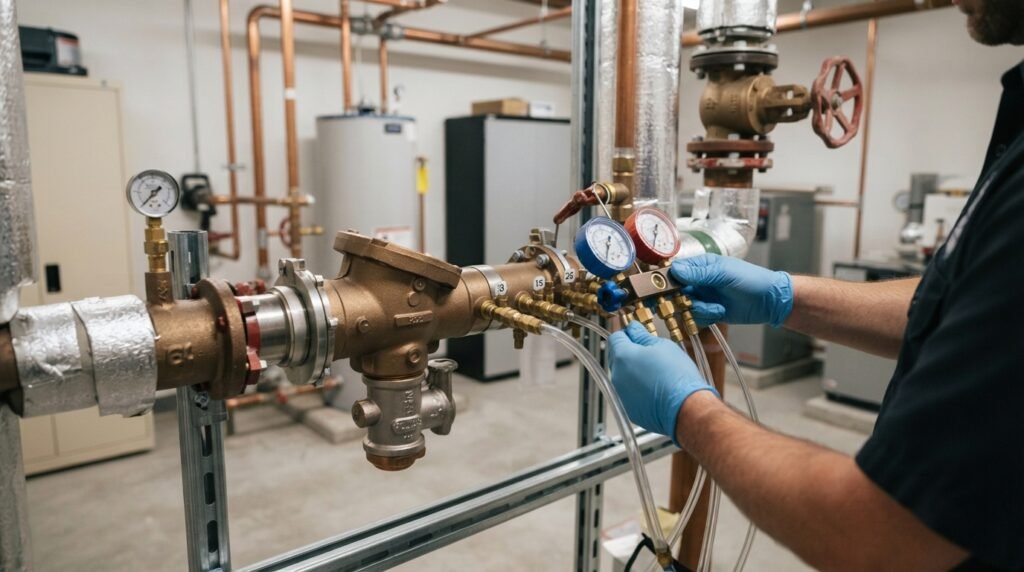
What Happens During Backflow Testing?
Backflow testing is more than simply looking at the outside of the device.
The applicable testing procedure depends on the type of assembly.
A typical service process can include:
- Identifying the backflow assembly.
- Inspecting its visible condition.
- Checking the relevant shutoff valves and test cocks.
- Performing the applicable field test.
- Recording the test results.
- Determining whether the assembly meets the applicable testing criteria.
- Identifying repair or replacement needs when necessary.
- Completing documentation as required.
Pennsylvania DEP’s training resources specifically cover field-testing procedures for RP, DC, and PVB assemblies, along with diagnostics and troubleshooting.
If you need to verify the performance of an existing assembly, backflow device testing is the appropriate service to explore.
What Happens If a Backflow Preventer Fails?
A failed test should be treated as a reason to investigate the assembly rather than as an automatic reason to replace it.
The process may look like this:
Test → Diagnose → Repair or Replace → Retest
A technician may identify a worn check valve, debris, damaged components, leaking parts, corrosion, freeze damage, or another issue.
If the assembly can be properly repaired and remains appropriate for the application, repair may be an option.
If the assembly is damaged, obsolete, unsuitable for the required protection, or otherwise not practical to repair, replacement may need to be considered.
For component-level problems, backflow device repair can provide a direct path from diagnosis to corrective service.
Backflow Repair vs. Backflow Replacement
Repair and replacement are not always the same decision.
When Repair May Be Appropriate
Repair may make sense when:
- The assembly is otherwise suitable.
- Individual components can be serviced.
- The device can be restored to proper operation.
- Repair is practical for the specific assembly.
When Replacement May Be Considered
Replacement may be appropriate when:
- The assembly is severely damaged.
- Required components are unavailable.
- The device is no longer suitable for the application.
- Installation conditions have changed.
- Repair is impractical.
- The assembly cannot reliably provide the required protection.
The correct choice should be based on the device condition, application, applicable requirements, and professional evaluation.
Backflow Inspection vs. Backflow Testing
These terms are related but should not be treated as identical.
Backflow Testing
Testing evaluates whether a testable backflow assembly performs according to the applicable test procedure.
Backflow Inspection
Inspection focuses more broadly on the device and installation, including visible condition, accessibility, components, installation concerns, and other issues that may need attention.
Backflow Repair
Repair addresses identified mechanical or component problems.
Backflow Installation
Installation involves placing a new or replacement assembly in accordance with applicable requirements and manufacturer instructions.
Understanding the difference can help property owners choose the right service instead of scheduling something they do not actually need.
Backflow Preventer Installation Considerations in West Chester, PA
A backflow assembly should not be selected and installed based only on its connection size or purchase price.
Installation can involve considerations such as:
- Accessibility for testing
- Accessibility for maintenance
- Drainage
- Freezing protection
- Installation orientation
- Available clearance
- Pressure conditions
- Manufacturer requirements
- Applicable water supplier requirements
For RPZ assemblies in particular, the relief valve’s discharge needs to be considered because the assembly may release water when operating under certain conditions.
The Pennsylvania DEP guidance also addresses accessibility, maintenance, testing, installation conditions, and protection from freezing.
If you are installing or replacing an assembly, backflow preventer installation is a useful service option to consider.
What Should West Chester, PA Property Owners Check?
Property owners in West Chester should focus on the actual plumbing connection and applicable requirements rather than relying on a generic device recommendation found online.
Before installing or replacing a backflow preventer, consider:
- What is connected to the potable water supply?
- Could backpressure occur?
- Could backsiphonage occur?
- What is the potential hazard?
- What type of assembly is currently installed?
- Has the assembly been tested?
- Is the device accessible?
- Is it protected from freezing?
- Does it have adequate drainage where required?
- Does the existing assembly still provide the appropriate protection?
- What requirements apply to the property?
Pennsylvania DEP’s guidance provides a framework for cross-connection control and backflow prevention, while also recognizing that water suppliers may have their own ordinances or standards.
Why Professional Backflow Evaluation Matters
A backflow preventer may look simple from the outside, but choosing the correct assembly requires more than identifying the pipe size.
The professional evaluation should consider the connection, hazard, pressure conditions, existing equipment, installation environment, and applicable requirements.
For property owners who are unsure whether they have a PVB, DCVA, RPZ, or another type of backflow assembly, starting with an inspection can be more useful than purchasing a replacement device before the system is evaluated.
Professional Backflow Solutions provides backflow services for residential and commercial properties, including testing, inspection, installation, and repair.
Professional Backflow Services in West Chester, PA
If you need help with an existing or new backflow assembly, Professional Backflow Solutions can assist with the next appropriate step.
Depending on your situation, you may need:
- Backflow Testing Services
- Backflow Installation Services
- Backflow Repair Services
- Backflow Inspection
- Backflow Device Testing
- Backflow Device Inspection
- Backflow Preventer Installation
- Backflow Valve Repair
- Backflow Device Repair
- Commercial Backflow Repair
- Emergency Backflow Repair
The goal is not to install the biggest or most expensive device. The goal is to identify the protection appropriate for the actual cross-connection and application.
Frequently Asked Questions About PVB, DCVA, and RPZ Backflow Preventers
What is the difference between PVB, DCVA, and RPZ?
PVB, DCVA, and RPZ are different types of backflow prevention assemblies. A PVB is designed to protect against backsiphonage but not backpressure. DCVA and RPZ assemblies can protect against both backsiphonage and backpressure, with their appropriate applications determined by the degree of hazard and applicable requirements.
What does PVB stand for?
PVB stands for Pressure Vacuum Breaker. It is a testable backflow prevention assembly designed to protect against backsiphonage.
What does DCVA stand for?
DCVA stands for Double Check Valve Assembly. It uses two independently acting check valves and can provide protection against backsiphonage and backpressure in appropriate applications.
What does RPZ stand for?
RPZ stands for Reduced Pressure Zone. An RPZ assembly uses two check valves and a relief valve to provide protection against backflow under applicable conditions.
Is a PVB the same as an RPZ?
No. A PVB and an RPZ have different designs and protection characteristics. A PVB is designed to protect against backsiphonage, while an RPZ can protect against both backsiphonage and backpressure in appropriate applications.
Is a DCVA the same as an RPZ?
No. Both can protect against backsiphonage and backpressure, but a DCVA uses two check valves while an RPZ also incorporates a relief valve and reduced-pressure zone.
Which is better, PVB or RPZ?
Neither is universally “better.” They serve different purposes. The appropriate device depends on the specific cross-connection, hazard, pressure conditions, installation requirements, and applicable standards or water supplier requirements.
How do I know which backflow preventer my property needs?
The appropriate device depends on the type of cross-connection, degree of hazard, potential for backsiphonage or backpressure, system configuration, and applicable requirements. A qualified professional can evaluate the existing plumbing and assembly before recommending testing, repair, installation, or replacement.
Does every property in West Chester need a backflow preventer?
Not every property necessarily requires the same type of backflow protection. Requirements depend on the property’s plumbing configuration, cross-connections, hazards, and applicable requirements.
Does an irrigation system need backflow protection?
Irrigation systems can create cross-connections that require backflow protection. The specific assembly depends on the installation, hazard, pressure conditions, and applicable requirements.
How often should a backflow preventer be tested?
Testing frequency depends on the applicable requirements for the assembly, property, and water supplier. Property owners should follow the requirements that apply to their specific installation rather than relying on a universal schedule.
What happens if my backflow preventer fails a test?
The assembly should be evaluated to identify the cause of failure. Depending on the condition and application, the device may require cleaning, repair, replacement, and applicable retesting.
Can a failed backflow preventer be repaired?
Sometimes. Repair depends on the assembly’s condition, available components, manufacturer requirements, suitability for the application, and whether the device can be restored to proper operation.
When should a backflow preventer be replaced?
Replacement may be considered when an assembly is damaged, obsolete, unsuitable for the application, impractical to repair, or unable to provide the required protection.
Can Professional Backflow Solutions help identify my backflow preventer?
Yes. A professional backflow inspection can help identify the existing assembly, evaluate visible conditions, and determine whether testing, repair, installation, or replacement should be considered.
Final Takeaway
PVB, DCVA, and RPZ backflow preventers are not interchangeable solutions for every property.
A PVB is designed around backsiphonage protection. A DCVA can address backsiphonage and backpressure in appropriate non-health-hazard applications. An RPZ can provide protection against both backsiphonage and backpressure and is used for applications requiring a higher level of protection, including health-hazard situations identified in Pennsylvania guidance.
The most important question is therefore not simply, “Which backflow preventer is the best?”
It is:
“What type of backflow risk does my specific property have and what protection does that application require?”
If you are unsure which device is installed at your West Chester property, whether it needs testing, or whether a failed assembly should be repaired or replaced, Professional Backflow Solutions can help you identify the appropriate next step.